2 February 2012

Rare Birds caught at Umzumbe Barn Swallow Roost

This week has already given 1 major surprise at the Umzumbe Barn Swallow Roost, yesterday evening the first bird caught was not a swallow but a Quail, and Harlequin Quail at that. This is a KZN rarity so of course now the extra work of filling in all the forms required begins, luckily I have a few photo's as proof like the following two pictures.

male Harlequin Quail


Then the previous evening I caught a young Redheaded Quelea, although not a rarity it is regarded in most circles as a nonbreeding winter visitor to our coast, despite the fact that I often catch adults in full breeding plumage as well as immature and juvenile birds like this.

juvenile Redheaded Quelea

30 January 2012

Last weeks best

Last week was very quiet except for the Barn Swallow ronging, over the last weekend I ringed 99 Barn Swallows making the seasons total so far 595 birds.

While I was catching swallows on Thursday evening the nets were being packed away and 2 stragler birds flew into the already closed nets, they were no Swallows but Little Bee-eaters, one of the most attractive birds on the Umzumbe Floodplain.
Little Bee-eater

A close up of the Little Bee-eater


I also went to investigate a Crowned Eagle nest in Hibberdene where I found the chick to be excercising his wings in anticipation of flying for the first time.

young African Crowned Eagle - I hate the tree though

15 January 2012

Ringing on Umzumbe Floodplain 15.01.2012

What a great day for ringing, cloud cover and no wind giving a great oportunity to catch some more Warblers and hopefully give some of the new visitors to the ringing sessions a chance to learn more about them. While we were erecting the nets the Eurasian Hobby was busy trying to catch the Swallows and Swifts that were already feeding just after 4.30am.
One of the first birds was the Great Reed Warbler, in fact 4 of them were caught throughout the morning. These Warblers are easy to identify on their size alone, although one person was totally confused as he thought it was a Terrestrial Brownbul, (he knew we had removed one from the net). Some of the other early birds were Yellow Weavers, African Reed Warblers, Redshouldered Widows etc.
male Yellow Weaver

Along with the birds that we would expect to catch in this area there was a male Red Bishop, a bird that has only arrived in this spot in the last few years.
male Red Bishop

Some of the other warblers included African Reed Warbler formerly known as African Marsh Warbler, also Lesser Swamp Warbler (Cape Reed Warbler) these are both common species in this habitat and totally expected.
Lesser Swamp Warbler
The best Warblers caught were 2 European Marsh Warblers, a lifer for the visitors as these birds connot be identified through binocs in Southern Africa as they are so similar to the european Reed Warbler which is uncommon and the African Reed Warbler which is very common. In the hand they are quite easy to sort out, the wing length on the African Reed Warbler is less thatn 60mm while they European Reed and Marsh are greater than 60mm. When it comes to the two European Warblers the Walinder Score comes into effect and the calculators come out to do the calculation.
european Marsh Warbler
One of the common birds that we catch here is the Rufouswinged Cisticola, and today we caught an immature which for some reason we don't get too many of, the lemon yellow belly and the yellow gape are easily seen, especially the gape contrasting with the black inside the mouth.
immature Rufouswinged Cisticola


To me one of the best birds was the final bird caught, although common in summer we don't catch many in this area unlike the ringers in Gauteng. The Diederik Cuckoo flew into the nets just as I thought it was time to take down the nets.
male Diederik Cuckoo


I want to go and terrorize the Weavers

11 December 2011

First Foreign Recapture of a Barn Swallow at Umzumbe

Updated


30.11.2011 will go down as the day the first foreign recapture of a Barn Swallow occured at the Umzumbe Barn Swallow Roost. We have previously had one recapture which was a bird that I had ringed there 2 years previously.

Adult Barn Swallow


During one of the many ringing sessions that will be held at the roost that hosts approximately 1.5 million birds, a total of 57 birds were caught of which one bird already had a ring on its right Tarsus. The ring had the inscription "BRITISH MUSEUM LONDON SW7" with the ring number X111901.


Barn Swallows flying around the nets

The information has been sent to England and we are waiting for the information as to who, where and when the bird was ringed, when this information comes through we will get to know the distance that the bird has travelled. Information returned by the BTO is that the bird was ringed in Retford, Nottinghamshire by the North Notts ringing group on 16th September 2011 as a first year bird. The straightline distance from Retford to the Umzumbe roost is 11 167km. The bird obviously has travelled further than this due to migration routes.

The British ringed Swallow


The Ring

The Ring


For more information please visit my website listed under the links "Barn Swallow Research"

27 November 2011

African Finfoot and Whitebacked Night Heron Breeding in Umzumbe

A few weeks ago I received a phone call from a Richard Hulley to say that his son Brangan had found the nest of an African Finfoot on his farm dam in Umzumbe. The bird has been present on the dam for ten years that I know of and possibly a lot longer.
African Finfoot incubating
The two of us investigated and found the nest on an Island in the dam, and low and behold it had chosen the one island that has a bridge leading to it. We moved around the dam and crossed the bridge and saw the nest with one egg in it (normally the clutch is one or two eggs), virtually nothing is known about the breeding habits of these birds, so this would be a good chance to record and learn something. The nest is in the branches of the tree over-hanging the water, at a height of about 50cm above the water. This is done so that if there is any disturbance the female can quietly slip off the nest into the water and swim away to avoid giving the nest location away. We also found another nest in the tree about 1m above the water and with four white eggs in it, the adults of which had flown off when we arrived on the island. 

African Finfoot egg

Whitebacked Night Heron eggs
Ten days later I went to check the progress of the nests and walked across the bridge, which this time after the recent rain collapsed on me when I got close to the island, so there was me up to my chest in water, binocs around my neck (now totally submerged), camera in its bag with phone and keys for save keeping, also in the water. A quick swim to the island and everything got laid out to see what damage had been caused, luckily camera and phone were still relatively dry and the binocs are gas filled. However the birds on the nest quickly disappeared with all the commotion. I investigated the Finfoot nest first and found the egg still intact; I then checked the other nest and found three chicks and one egg. Now to sit patiently to see what would happen. Firstly the Finfoot came back and continued incubating allowing me to take a few pictures, then after what seemed forever one of the other birds flew back and I was able to identify it as a Whitebacked Night Heron, so we have a new breeding record of this most elusive and rarely seen birds. 

Whitebacked Night Heron chicks
The trouble came three days later when heavy rain fell at the dam with 75mm falling overnight on Friday. On Saturday I went to have a look without going onto the island as a good viewing site had been found looking straight at the African Finfoot nest, however the Whitebacked Night Heron nest is not visible. The water level in the dam had risen to the point of almost touching the Finfoot nest, the nest has been abandoned and was at an angle of 30deg off horizontal, the only hope now is that the egg hatched on the Wednesday or Thursday as being a water bird the chick is able to swim at two days of age. My plan was to borrow a small boat and conduct further investigations once the weather improved. 

African Finfoot nest after the rain
A week later the rain haf stopped so I went to the island after borrowing a small boat. I paddled to the island to avoid too much noise and was shocked at what awaited me, The Whitebacked Night Heron nest is also devastated and there were no sign’s of the chicks so we must assume that they have perished, Roberts 7 gives the nestling period at around 40 days, and records that the chicks can climb around the tree at about 21 days, these chicks are only 11 to 12 days old, and no sign could be seen.
Whitebacked Night Heron nest after the rain

14 November 2011

Bird Ringing - Umzumbe 13.11.2011

A great day of ringing on a day surrounded by terrible weather, however Sunday the wind stayed away as did the rain and cloud cover made for a an extended ringing session.


The first of 2 immature Gorgeous bushshrikes caught and ringed


Tawneyflanked Prinia


Ashy (Bluegrey) Flycatcher


Balckbellied Starling


8 November 2011

Latest bird pictures in the Garden


Redwinged Starling - female


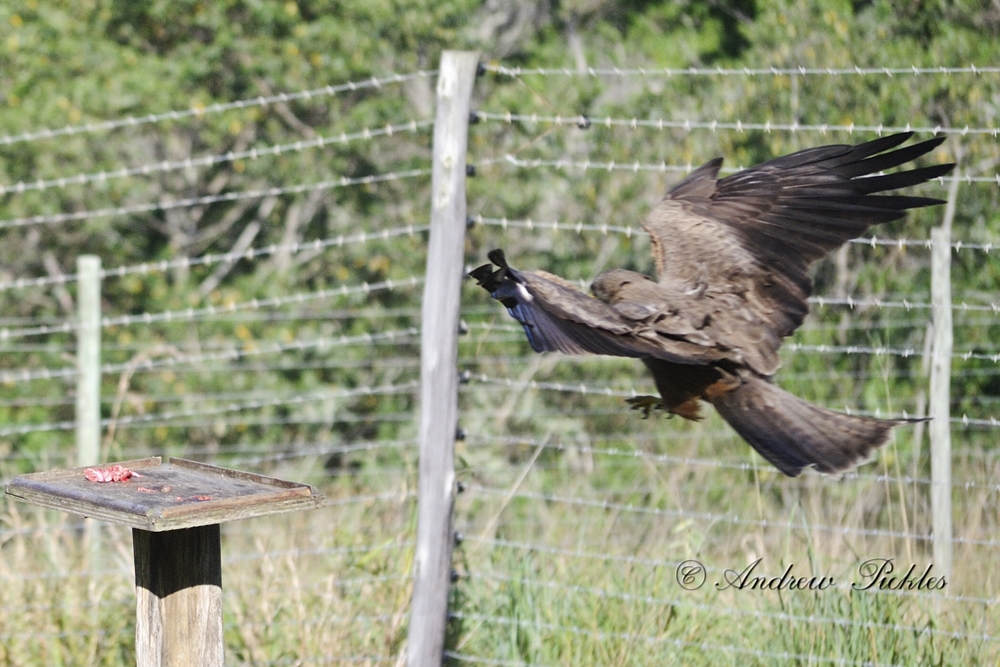
Yellowbilled Kite coming for his food


sub adult African Harrier-Hawk (Gymnogene)